And on the other hand...

Click here for The Yin Side where the other half of me holds forth!
Showing posts with label Tao. Show all posts

Monday, October 7, 2013

Sit-down Comedy: A Running Gag (Part 2)

Traveling back to someplace always makes you reference previous visits, and this latest to Wudang is no exception. Novelty is replaced by routine and ordinary, but no less wonderful.   I'm sure my companions got tired of my constant comments,  "When I was in Beijing in 1988..." and "This hotel used to be moldy..." and "When I broke the hermit's stool...".  That last reference has to do with my big western butt overwhelming a delicate wooden stool provided to me by the famous Bee Taoist. In the middle of a solemn little talk about Tao, my stool suddenly collapsed, put me on the ground in a big sudden shift in yin/yang, and provided the hermit with some new bits of firewood.

When one of our companions this trip was having some trouble getting a proper ticket from Beijing to Wudang with the rest of us in hard sleeper, he was encouraged to do what countless desperate Chinese must do: buy a little portable stool to sit on during the nearly 24-hour overnight journey in a crowded cattle car. (There are hawkers roaming the station selling stools for just this purpose.)  I joked about my stool adventure, and we decided that we would make a trek to present his little stool to the hermit as a kind of offering...assuming he would remember.
 
The stool became something of a sitting joke (as opposed to a running gag) for much of the journey. We never did deliver it to the Bee Taoist, who did remember me, but probably not because of the stool episode.   I gave him a copy of my Chinese-style ink portrait of him and a photo from our previous visit, and inadvertently left my Camelbak bottle on his little terrace, guaranteeing that I had to visit him one more time to retrieve it. (I was dropping and forgetting things all over the place on this trip; some practical lessons in attachment, or just paying attention.)
Bee Taoist Jia Ye (and a tiny Sufi), September 2013. 

I would like to know the story of this. This is like finding a statue of Lao Tzu in a mosque.
Later in Beijing, when I was alone after the last of the group had scattered, I spent an afternoon in the National Art Museum.  I never did find the shui-mo shan-shui scrolls I was looking for, but did stumble into some unusual modern installations, in particular, one involving...stools.  I guess I could call it an instoolation.


So the stool metaphor continued through the end of our trip and then some. If I can consider it a metaphor. (There were not a few stool jokes made related to the previous blog post. You can get very preoccupied with stool in China.)  The train stool purchaser and veritable art critic commented that the installation "represents the non-linearity of the journey of learning that we undertook interspersed by reminders of our humanity within the unfolding humanity of China.  I am glad I was sitting down on my stool at the time I opened these [photos] as I couldn't believe that someone could actually mutilate such objects of beauty..."  I couldn't have put it better.

Monday, May 27, 2013

Change

My frequency of posting has diminished.  Only a full moon, a haircut, a holiday seem to push me to say something here.  I watched the kolea leave, on schedule, life pulses on.  If things had gone as planned, I would be just returning from China: two trips cancelled because of lack of participation, but I think I have nailed a solid opportunity to return to Wudang for an extended retreat in September. Not too far off.  The agenda will, I hope, include study of the I Ching, something of the core of Taoism.

A lot of traffic on Facebook and elsewhere, Tao discussion groups, where Lao Tzu memes pop up with regularity, pitting Tao traditionalists against new age newbies, wondering what IS the central key concept of Taoism.

I say it is change.  Nothing is permanent, detritus piles up.  Hanging on to the detritus is foolish, though it tells us something about ourselves.  Amongst the floor sweepings we find a pearl and a bit of silver;  a jade carving encased in gold.  Keep those, the lasting yin and yang.  The rest is trash.

Saturday, February 9, 2013

New Year's Eve, Yin Style

I was in Chinatown yesterday, primarily because I wanted to buy some Chinese ink, but it was all festive so I wound up with door couplets, some snacks, a couple of movies that my Chinese video vendor had put aside for me (knowing I will buy anything she puts aside for me), and some Year of Snake T-shirts.
Local T-shirt design, says "Zing to the Dragon Zang." Not sure what that means, but the design is nice.
I've been trying to paint snakes, but haven't found the energy to really concentrate.  The snake character, 蛇,  lends itself, in running script, to some nice snake motifs.  But I am not yet prepared to show my meager efforts.  But in some fit of prescience, I did take this photo in Washington last August, at an exhibit of Chinese dissident artist Ai Wei Wei's bronze zodiac animal heads.  They were awesome.
Ai Wei Wei's bronze zodiac animals at the Smithsonian; "Move over dragon, I''m snake and 2013 is my year."
I spent this day, the eve of Spring Festival, watching Chinese movies and making...chop suey.  I've been reading Andrew Coe's very intriguing "Chop Suey--A Cultural History of Chinese Food in the United States" which traces the American taste (or lack of it, or even revulsion to it) for Chinese cuisine from 1784 (when the first American voyage to China set sail)  to P.F. Chang's.  Chop suey, something I've never really encountered in China, is a melange of stir-fried stuff with rice or noodles...mine was pretty tasty, since I have routine and ready access to fresh ginger and Chinese parsley, good local soy sauce and salted black beans.  I was clearing out vegetables in the fridge to mix up with some leftover char siu and roast pork.  It was an inelegant but toothsome mess, and I apologize to the kitchen god for even suggesting that it was Chinese.  But it still tasted better than the old La Choy canned chop suey I grew up with, thinking that was authentic Chinese cuisine.
Looks bad, tastes good.
The movies...with a nod to the new snake year, I re-watched Jet Li's recent retelling of the white snake legend, "The Sorcerer and White Snake."  I liked it better than the first time around, although I still prefer "Green Snake," with Vincent Zhao, even if Vincent's portrayal of the monk is a bit more evil and goofy.  (It's not the first time Vincent and Jet have played the same roles.)  And then a little Hong Kong indie oddity,  "A Side, B Side, Seaside" set in one of my favorite Hong Kong locales, Cheung Chau, where I would actually like to be to celebrate this Chinese New Year, not that Honolulu isn't perfectly lovely.  

Some mandarin oranges (Cuties, clementines) for dessert and yet another HK movie, something contemporary with the other Tony Leung (Ka Fei) who I wouldn't have recognized had my video vendor not pointed it out to me.  Andy Lau appears in it too, as he appears pretty much everywhere, but was not obviously credited in my DVD package.
Not as cute as Vincent Zhao, but tasty anyway.
Xin nian kuai le, ever'body!  Gong xi fa cai!

Monday, August 27, 2012

Stuck in Neutral

After the milestone of TAO 61 making 225,000 miles, everything else in August seemed anti-climactic.  But not, really.  I have been exhausted after hectic business travel to Washington, D.C., returning home with a bad summer cold (though made bearable on the long return trip by the fortuitous upgrades to first class--real kind, with full reclining seats and elbow room and custom-made ice cream sundaes and free booze and real cutlery and dishes for real hot food. I don't quite know what I did to deserve it.)

Then an all-day program/presentation in which I had to teach faculty about research grants.  At first I approached that task in utter fear and not a little loathing, but it turned out to be a cat-herding exercise. And now people know me and what I do for them. 

The real pleasure of the month, counter-balancing the disappointment in the collapse of my September China trip plans, has been my Chinese painting class, with an extraordinary teacher who has taken my studies up yet another level.  I was painting images of my Taoist hermit, which kept coming out sad, despite his reputation for cheer, probably channeling my frustration at not being able to visit him and make obeisance in his little cave temple.  But finally, I laid in a sketch in ink, which only needed to be intensified with some color.  My teacher helped with that, so the final result is a true collaboration.  Not yet properly mounted, or signed, I share it here in its wrinkled state.  I don't want to mount it without laoshi's assistance. But I want to share it.
Jia Ye, by Laoshi and Me
Any morning now I should notice the returned kolea; my Chinese haiku-writing friend saw one a few days ago and penned this:
 
on my neighbor's roof
sighting of first kolea
autumn closing in
 

I should get brush, ink and paper together to illustrate it.  If I can't fly to Jia Ye, the kolea at least can come to me.

Saturday, July 28, 2012

A Change of Perspective

When confronted with annoying change, sometimes the thing to do is simple: change your own perspective.

Over the past couple years, I have been fighting disappointment and anger over the callous action of my condo association which is just a little too chainsaw-happy.  When they cut down two huge albizias,  (allegedly some sort of threat), whose treetop-level flowering I always enjoyed from my tenth-floor lanai, I was devastated and angry.  My night-time meditation practice, my morning coffee, my afternoon reading, was disrupted, ruined even. Now I had a glorious view of...the parking lot! These majestic trees, I often said, were what made me love my otherwise very ordinary apartment, the asset that spoke to my soul.  I began to retreat inside, and nursed the wound as if my own trunk had been sliced just at the root.

Only just recently I discovered all I had to do was move myself, my chair, my cushion, to the other side of the lanai.  Moving some potted plants around to block the view of the parking lot, and reorienting my view from the northwest to the southwest, et voila, I have a peaceful natural space again.  I still miss those trees, the way I miss my parents, my aunts and uncles, cousins, and friends who have passed on.  When I meditate, I can still feel their presence.  But just by shifting my position, I find all is well.


Thursday, April 12, 2012

Obsessed with Happy Birds

Ignoring the obsession everyone else seems to have with Angry Birds, I find much more pleasure and peace in Happy Birds, specifically the kolea, Pacific Golden Plovers, who are looking increasingly pleased with themselves every day.  It's been so rainy this season, I haven't been observing them as regularly as I might, paying a little more attention to the road conditions while on my daily commute. But this morning, a "shiny" day, as my beloved Chinese guide would call it, I saw several along the road.  Plump and fit, all spiffy in their dating clothes, they will lift off for Alaska before the end of the month. 
Kolea in Breeding Plumage

More than anything else, these birds and their regular migration have been symbols of Tao for me, in their relentless cyclic travel across the ocean (that low and most vast of watery places), to and from Hawaii and Alaska, to breed and then come home.  To what strange purpose these birds live, except as manifestations of Tao. 
The Compleat Kolea
The Wizard, in the passenger seat (his pussycat car is in the shop so he has to endure the noisy, un-air-conditioned, cramped TAO 61)  said, "I worry about them with all the feral cats around here." 

"They have incredible wingspans for their size," I pointed out, "they lift off strong and quick. They would do well on aircraft carriers.  And any creature that spends its days picking tiny edible bugs out of the grass probably is ultra-sensitive to an approaching feline."  I've seen plenty of pigeons and mynahs, sorry victims of cats and cars, but never a kolea shredded or squashed on the road.  The Wizard returned attention to his phone on which he was playing solitaire (not Angry Birds, not his style) before making the regular morning call to his dad on the mainland, 92 and alert and ready to discuss the day's news, his computer problems, and medications.  As I listened to the one-sided conversation, I realized he never mentioned the Happy Birds.  I guess it's just my obsession. Put aside the Angry Birds: do some kolea watching of your own; these birds are charming.  They'll make you happy.

Thursday, February 23, 2012

Moon and Thunder

Funny few days, a lot of Tao discussions on several forums sparkling my brain, then Ash Wednesday, a Catholic holy day, but with, for me, oddly Taoist overtones.  All that ashes to dust stuff and beginning of a set period of self-examination, above and beyond the self-exams I do pretty much constantly.  (I could accomplish something serious if I meditate regularly over the next 40 days.)

I failed to notice that today was in fact not only the day after the ash day, but also the birthday of Tu Di Gong, the Taoist Earth God. "Why today?" I asked a forum participant. "Is it lunar?"  And indeed it is. Everything is connected, in synchrony with sun and moon, yang and yin, breathing in and out, send and receive.
"Shengri kuaile, Tu Di Gong!"
Much earlier today I had been reading from Thomas Cleary's translation of Understanding Reality (Wu Zhen Pian), a verse called "On the Crescent Moon Furnace. " (What do you read in the passenger seat on your commute?)  This is a treatise on Quanzhen Internal Alchemy, neidan, by  Zhang Bo Duan,  dating from the Song Dynasty.

"Stop wasting effort at an alchemical oven;  to refine the elixir you must seek the crescent moon furnace. It has of itself the natural true firing--you do not need purple coal or bellows."  There are a lot of obscure metaphors here.

In the accompanying commentary by Liu I-Ming, I read:

"The crescent moon refers to the moon of the third day of the lunar month, appearing as a hook of light in the direction of earth (southwest). That light curves upward, that is why it is called the crescent moon  What this crescent moon symbolizes in humans is a point of yang light shining through in the middle of extreme quiet.  Among the trigrams, it is thunder (two yin lines over one yang)."

So it was like a little burst of thunder when, driving home, the Wizard pointed his finger to the west where the crescent moon was setting. (I pulled out my iPad to confirm the status of the moon, waxing gibbous, one day after the dark moon, with a nifty little app called Luan.)  Not only a nice upturned bowl (impossible to photograph) settling over the mountain, but a remarkable vertical alignment with Venus and Jupiter (confirmed with another nifty iPad app called Starwalk). Looks like Uranus is in the line too, but not visible from where I am.  Suddenly the alchemy text, the Earth God birthday, and my own odd energy all combined, mixed up in that crescent bowl.  Duh.

Energy shifts.  The calendar moves on, filling up and emptying. I was thinking life would be boring in the near term, but not only did I enjoy my regular weekly lunch with a friend today, but tomorrow the third and final opera of the season (Bizet's Pearl Fishers) gets underway, and I have tickets to see the Dalai Lama in Honolulu April 15, and I think I have a business meeting in Kona later that week.  Something's going on in March too, but I'll have to check my calendar to remember what it is.

+++
Actually, I come to discover, that the 22nd was Tu Di Gong's birthday, and the 23rd is the birthday of the God of Literature, which seems appropriate.  And in March, I have a dim sum date with a friend! Perhaps that will be a food god date?

Friday, December 30, 2011

My Tao

(Another offering for Rambling Taoists, you can read it here first.)


I've been contemplating a New Year's resolution, to go eremetic, to stop ruminating, to stop reading,  to stop Facebooking, YouTube-ing, blogging, forum-ing, basically, turning inward to paint and make music, drink tea (and a little Nigori ) and contemplate clouds and rainbows from my lanai, with some qigong and meditation thrown in at appropriate times.  A basic quiet lay-Taoist lifestyle.  I was even ready to ask Trey to take me off the masthead here, saying "So long and thanks for all the fish."

Part of this is due to too much participation, too much red dust and noise, even though much of it has been Tao-talk-related.  Pose a simple question, raise a simple point, and you get arguments, sanctimony, tutelage and weird flavors of Tao (Advaita Tao, Zen Tao, socio-political Tao, quantum physics Tao, self-transformation Tao, self-negation Tao, TCM Tao, environmental, cultural , esoteric, orthodox, hippie, new-age Taos...it goes on and on.)  In just the past week, not just on The Rambling Taoists, but in other forums, there have been deep and sometimes disturbing discussions and postings --some of which leave me feeling like I'm the receptionist in the waiting room of a mental health clinic-- about guilt, free will, karma, text translation and exegesis, authenticity of practice, Chinese vs. western, ancient vs. modern, Lao Tzu vs. Jesus.)  All of which suggests to me that the real truth in Taoism is the contradiction and paradoxes it allows.  So many Taoisms, so many Taoists.  (But just one Tao.)

Particularly perturbing to me is a notion expressed by Ta-Wan,  that  "We are little else than a sensitive spot in the universe."  Even if this is the case -- which I'm not sure it is -- why would you want to believe it? Why would you want to act as if that is true?   That we are no more than trigger hairs on a Venus fly trap, the responsive leaves of a mimosa tree?  This is a genuine question, not rhetorical astonishment. Even with quoting the masters (who are in fact, just some guys, like us, with something probably lost in translation), or with reference to direct experience (to which another cannot be a party), I cannot sign on that dotted line; it leaves too much out. 

We are more than amoeba…we are self-aware energy beings.
We are particle and wave.
We are matter and energy.
We are here, in space.
We are now, in eternity.
We are body, mind, and spirit.
We are human beings, feet on earth, head in heaven.
We are sentient and knowing.
We are cause and effect.
We think and feel.
We are the freedom in a deterministic universe.
We are poems that “be”  and stories that “mean.”
We are science and religion.
We are technology and art.
We are certain in our uncertainty; uncertain in our certainty.
We are born and die against our will, but while living, we exercise and express will.
This I believe, and this I act.

Tuesday, December 13, 2011

Head in the Heavens, Feet on the Earth

(Another post I expect to offer to Rambling Taoists, but you can read it here first.)

I've been thinking, yes, about a little remark Ta-Wan made earlier:

"I live life as it appears to be and I die. My life is full as no time was spent attempting to know what can't be known. I live. I don't think about living."

Which on the surface seems to be very Taoist, very spontaneous and in the moment.  I feel this way whenever I enjoy a maitai under the big banyan tree on the beach in Waikiki, gazing at Diamond Head, watching the surf, hearing the joy of children and laughter of lovers on the sand.  This is about as close to Paradise as I can imagine, but I don't get there as often as I would like.  (Getting to Waikiki is a nuisance.  I can do maitais on my own lanai.)

But in the context of our talk of "philosophical" Taoism, I wonder...philosophy is about asking questions (with no expectation of answers), but still the asking of questions, pondering arguments, seems like a worthwhile pursuit to me.  Or maybe I'm too Socratic.  My feet are on the ground, but my head is in the clouds.

Years ago, maybe 1967, I asked a friend, "Why are you experimenting with all these drugs?"  Experimenting was the term of the time; now people just "do" them, I guess.  Experimentation appealed to me.  It suggested research, discovery and proof. Hypotheses and their testing.  But his answer to my question was, perhaps the most honest thing anyone's ever said to me, "Because it's fun."

And now, I find, decades on, the drugs and alcohol are no longer fun, and if anything they were just fiddling with the fine tuning of the so-called cognitive shen--the sense faculties.  A useful exercise, but it's no wonder we talk about burn-out and flashbacks and distortion.  Like a little kid with a remote and a screwdriver, fool around with the controls too much and you may break the set. And in this case, you can't go to Best Buy and get a replacement.

But I'm not really talking about psychoactive substances here: I'm talking about thinking.  It's fun to think about living, doing logical exercises to test hypotheses about the meaning of life, causality, God, memory, consciousness.  Not expecting answers.  Just filling in some blanks, considering new possibilities.  One is never done.  You don't burn out from thinking. I think.

Which brings me to the real purpose of this post.  Trey asked us if we might suggest ideas for holiday giving, for those inclined to do so in spite of  materialism, the economy and the competitive shopping season, (an issue I leave to others to debate). As a big proponent of lifelong learning and thinking, I direct attention to The Great Courses, products of The Teaching Company.  I am in no way a rep for the organization, although I've certainly earned some frequent thinker miles on my account.  No matter what a person is interested in, there's a top quality lecture series just for them.  "Them" is probably a demographic of reasonably affluent, already well educated people who have been out of school for a long time and who might want to revisit that course, or pick up one that was never offered in their major. Anyone who is a commuter and a thinker, an explorer, would appreciate these on long freeway drives.  I don't like audio books, but lectures are meant to be listened to.  No need to spend the money for DVDs; the audio CDs are compelling, and you can always look up any visuals later on the web.  One caveat: don't spend the "full price"...eventually, everything goes on sale.

And if you don't want to spend that much money, here are some other ideas:  I often give Deng Ming-Dao's 365 Dao as a gift that can keep on giving, year after year, even. (To me, since 1992.)  But this year, a special recommendation: former NPR reporter Eric Weiner's Man Seeks God: My Flirtations with the Divine, just out, about the author's exploration of several faith traditions, seeking something he can use.  I think it might appeal to readers of this blog. A self-described gastronomical Jew, he visits Sufis, Buddhists, Taoists, Franciscans, Kabbalahists, Wiccans, Shamanists and Raelians. It's funny, it's serious, it is even more entertaining and thought-provoking than his previous Geography of Bliss.  The fact that I have a minor speaking part in Chapter 5 might be enough to intrigue you.

So those are the under $100, and under $20 categories. If you don't want to spend money, give something from your hand, your  heart or your head.  Homemade jam. Knit a bookmark.  I'm making little brush paintings.

I think it's good to give.

Saturday, October 29, 2011

Brush Lessons

Another post for Rambling Taoists...but you can read it here first:


Brush Lessons
There’s a lot of discussion here at RT about self and no-self, reality and non-being, socialism and capitalism, I think sometimes a lot of yammering, but none of it compares with my relationship with my wolf brush.

I have sometimes talked about the necessity of practice, the actual doing of something, just you and the something, to understand Tao: qigong, meditation, study of classics. But my newest teacher has a bamboo handle and is so flexible and responsive to the moment, I have come to see painting as a kind of energy practice and a teaching of how to regard the world.  Of course, this is nothing new: the Chinese painting masters have always been driven by Tao in their compositions and subjects.  Painting as an activity is a two-way street.  I actually look at things differently, and the attempt to “capture” the energy is a humbling lesson. This may be why Matteo Ricci, the great Jesuit who loved China and was beloved by the Chinese, never quite “got it.”  As a painter he was still trapped in a Western vision of the world, unlike Castiglione, another Jesuit who is considered to be a great Chinese painter.

I have been blessed to study with a wonderful woman, my age, trained in classical techniques in Fujian and Taiwan, and who has “transmitted” some sort of energy to her students.  She’s a Christian, is learning English through Bible study (as I learn Chinese through Tao Te Ching study), wears a delicate golden cross at her throat, but says her mother was “a Buddha.” (At my throat is an ancient faience Egyptian wadjet eye, which has nothing really to do with Tao…or does it?) She is a taijiquan practitioner and freely refers to and demonstrates the qi required in painting. 

Two years ago, when I was obsessed with landscapes but not her bird and flower emphasis, she said, “Maybe in two years you paint a flower.” While landscapes are still my preferred subject, lately I have been enjoying the Four Gentlemen and doing roses, peonies, and fuschia. With the coming of autumn I’ve been painting a lot of chrysanthemums.  She is so prescient.  Once I presented three versions of something for her review.  “Ah, this one is best,” she said. “You did it first?”  She was right.  Spontaneity is a key element in Chinese painting of the xieyi type.

I was just doing an inventory of my paint and brushes.  I have acquired lots of tubes of Western, Japanese, and Chinese watercolor, including the strange pricey pans of bright kawaii Japanese color (from my Korean teacher). I told the Wizard, “If you see me drooling over some paint box, please to remind me that I need no more paint.”  In fact all you really need is a good indigo, a good yellow, some sort of red, black ink and white gouache; everything derives from those, a sort of yin-yang melding of CMYK and RGB.  Although that sounds so PhotoShop, which is completely antithetical to what goes on with the brush, the ink and water, and the paper; there is nothing spontaneous about bit-fiddling. And generally, you can't modify anything after the brush meets the paper.

And I have a lot of wonderful brushes, but there are really only several I use consistently.  A couple of wolf brushes, a couple of fine-line brushes, and a nice stiff shan ma (mountain horse) brush. This all suggests that the real key to painting, and probably any other thing you want to do, is about skill in using simple tools with well-taught and well-practiced technique.

Saturday, July 2, 2011

Sun and Moon Obsessions

Although the Summer Solstice came and went, marked largely by my beginning a new job...auspicious for me, I guess, but no one else, I note today, once again, that it is the mid-point, the yin/yang pivot really, of the Gregorian year, as many days ahead as behind. Just past new and dark, the moon begins to wax today (wax on/wax off). This weekend, a chance to regulate my breath, contemplate the cycles of my life, clean a closet, make a painting, get a haircut, finish the intriguing A New Interpretation of Chinese Taoist Philosophy - An Anthropological/Psychological View, by You-Sheng Li, Ph.D. (2005).

I acquired this volume of apparently self-published essays (which I recommend to fellow Tao-seekers and persons interested in Chinese cultural studies) almost two years ago, but it only just recently jumped off my shelf, after my return from Wudang Pilgrimage IV (吴朝圣四). In it Dr. Li hangs many of his arguments on an anthropological distinction between primary and secondary society (echoing the pre-heaven and post-heaven Taoist concepts). In an essay called "The South and The North," in a subsection "Social Power and Talented Culture are Separate," he writes (in a somewhat Aristotelian way):
Industry is near the military side, while education and academics are near the basic human nature side. ... Universities and academic institutions are places where human talents are concentrated. ... Military power is measurable and material stuff is measurable but human nature is not measurable.
Now I understand why I may be happier, in a Taoist way, in an academic institution (even though doing essentially the same things, managing proposals) than I was in a high-tech firm that did network security R&D for the DoD. I became frustrated at the over-emphasis on metrics and processes, at the expense of human nature, that seemed unrelated to the actual good we might have been accomplishing. To articulate this at this pivotal moment in the annual cycle seems significant to me. Tao manifests itself in my life in the most surprising ways.

Ah, now to that haircut....

Sunday, May 8, 2011

Xuanzi Jiandan

That may be bad Mandarin, 选择简单, but I think it means "choose simplicity," which I have. The smaller bag is packed, and a rucksack for carry-on is loaded with my iPad, two pocket point-and-shoot Casios (forget the Nikon SLR with extra long lens and the Sony videocam), my phone, an extra iPod and a couple of phrase books, including Outrageous Chinese--A Guide to Chinese Street Language. While it's fun to know how to talk like a sailor, it's wise to know how not to, as well. (In Chinese you can make some bizarre mistakes. For all I know, the title of this post is "choose sodomy.")

I would like to carry Peter Hessler's Country Driving, which I haven't finished yet, but it's a heavy hardback. I am taking Terry Pratchett with me to the Counterweight Continent (Interesting Times) and I have lots of reading material on the iPad. I packed my brushes, ink and some paper (as if I can't get them in China). I am not taking any tea.

I do not anticipate blogging on the road, behind the Great Firewall, but one never knows. It may be a useful exercise in simplicity to make my observations in my little Moleskine notebook with my favorite 0.07 mechanical pencil.

I do know that, even in the mountains, anything I think I might need or have forgotten can be easily obtained. There's not much to need really.

So, see you all in June!

Monday, April 18, 2011

Day 108...Again

In its constant return year after year, today always seems like just yesterday. Or maybe I'm just getting old.

I observe this morning it is again Day 108. I quote from Deng Ming-dao's 365 Tao below. Some of my numerologically inclined readers may find this interesting.

NUMBERS

One gives birth to two, two gives birth to three,
Three gives birth to the ten thousand.
One hundred and eight counts make one cycle,
Constant turning creates all things.

Today is the one hundred and eighth day. Why are numbers so important to those who follow Tao? Even today, when numbers are more commonly yoked to the service of finance and engineering, there are those who revere numbers with the cheap version of mysticism -- superstition. Numbers form a closed world with mysteries to explore and exploit if our understanding is deep enough.

Followers of Tao emphasize certain numbers : One is the unity of Tao. Two is duality. Three is the unevenness that will generate movement. Four is the seasons. Five elements generate the world. Six parts of the body are the arms, legs, head, and trunk. Seven is the day of the waxing moon by the lunar calendar. Eight is the number of divination. Nine is the number of life. Ten is heaven's cycles.

There are twenty-four periods in a year, each with its own characteristics. Thirty-six is six squared. One hundred and eight is three cycles of thirty-six and represents a greater cycle, although there are even more esoteric connotations attached to it.

Numbers are only symbols, a way for human beings to project order upon the universe. They are a language more precise than words. But does Tao talk? Numbers are important to master, but take care to look beyond language and numbers to the true reality that they foreshadow.

And, oh yeah, just in case you didn't notice, last night the moon was full. This has been a year of interesting congrurences in the cosmic cycles of yin and yang.

Thursday, February 10, 2011

Success and/or Failure

Recently I was in a conference room where there was a plaque on the wall that said, "What would you do if you were guaranteed that you could not fail?" That's one of those ubiquitous quotes, like the serenity prayer, mantras that organizations use to express their wishful corporate philosophies, to stimulate (or possibly just simulate) positive thinking and achievement.

I was searching for the origin of the quote, and found another version:"...if you were guaranteed that you would succeed." Whatever, it's like asking is the devil or god in the details? (Actually, it's god, the devil quote is a derivation, but widely and more frequently used.)

Which got me to thinking, why must we frame everything we do in terms of success and failure? (Maybe Nike has it right: "Just do it.") I sometimes feel beset in a world seeking growth and improvement, feet held to the fire through processes and procedures, metrics and measurements, profit and loss, time and money. Good and evil, god and the devil. Right and wrong, rights and wronged. As if living was just a matter of applying an algorithm.

I would rather ask "What would you do if success or failure didn't matter, one way or the other?" I think that's the real question. Does a guarantee of a "successful outcome" matter? If not, those are likely the things you might really want to do.


I should go do some goal-less meditation now, but I need to get ready to "go to work," the extra-curricular thing I do to put my way through the lifelong-learning courses I have signed up for. Once I went to school to build a foundation for a career. Now I have a career that feels like something I do to put myself through school.

A word from the older but wiser to my younger readers: find and maintain work that isn't separate from what you love to do. And think about what you would do if you had all the time in the world. (Well, you do, really...it's probably money that holds you back, time and money being too often conflated. And there's the rub.)

Saturday, January 29, 2011

The Nature of His Game

The three-part Hawaii Opera Theatre's season opened last night with Faust. As a non-opera-loving friend said earlier, "That's the one about the guy who sells his soul to the devil, right?" Indeed, the Faust legend is deep and complicated and, despite an opera plot that seems dated by contemporary standards of drama and real life (who cares if someone has a baby out of wedlock, conceived by a devil-driven rogue) still has a lot of appeal in an era where moral integrity and success seem to be so easily compromised, at least as witnessed in economic and political news of the day.

Throughout the well-received production, I was looking for Taoist themes, an exercise that seems a little like meditation, to the extent that between acts I was googling on the iPad, Faust+Tao, but found nothing really. (Not talking, the Wizard was playing solitaire on his iPhone, willing himself to suppress the flu-based cough he's had since MLK Day.)

The opening act was stunning. Decrepit and sooty (oh wait, this is Gounod, not Wagner), Faust is complaining to a corpse on a gurney about his frustrations with philosophy, science, and religion to explain life...and dammit, why must he get old? (Well, don't we all, d'un certain age, ask that one?) Suddenly the corpse animates. A lithe stylish, tastefully leather-clad rock star arises from under the shroud.

"Please allow me to introduce myself," he seems to say.


Then you notice the tiny horns sprouting from his forehead, and there is indeed something troubling about his game. Sympathy for the Devil was not part of the score, but this guy (Jamie Offenbach, Hawaii-born, but with roots even less developed than Obama's) could have done it really well, channeling Mick the way Johnny Depp does Keith in his pirate persona. HOT's devil-in-leathers also sported gorgeous long shiny silky black hair that rivaled any of my Wuxia heroes'. His little nubs of horn kept growing from act to act, and by the finale it was pretty obvious who he was; his smooth leather pirate boots grew a lot of goaty fringe and cloven-toed hooves and he looked more and more menacing. Though not the protagonist, he kinda stole the show. (Or maybe it was just me.)

Mephistopheles...Satan!... appears to be a manifestation of Faust's deluded craving for knowledge and lust for youthful life (especially in the form of a chaste young lady.) Kind of a Taoist theme, I guess, with really horrible consequences.

The final scene in which the naive Marguerite, shunned and imprisoned for giving birth illegitimately to Faust's child, languishes, even killing her infant, in her jail cell. Faust and the Devil appear on the scene of battle over her soul. We think Mephistopheles wins: "Judged!" But no, it's almost a reprise of Shen Yun, and the angels sing, "Redeemed!" Marguerite casts off her earthly shell and ascends to heaven. With the dead baby left lying on the prison floor, it's a creepy scene, and I longed for the Falun Gong angels to descend to take HIS poor soul to Heaven's Gate. There are some unresolved plot points here.

Now that I'm thinking of it, Shen Yun was the opener of the opera season, which this year at least includes no Wagner. Next up, Lucia di Lammermoor, which shares place setting, though not plot, with Brigadoon, a Lerner and Lowe Broadway musical in which I was a chorus member in a high school production. That was a period when kilts were faddish, something that occurs from time to time. Off-hand I can think of no other Scottish-themed extravaganzas, except Mel Gibson's Braveheart, which I don't think had any kind of musical enhancements. Just half-naked men being tortured, a favored theme of Mr. Gibson's.

And today...Lunar New Year festivities in Chinatown. I look forward to seeing the 150-foot-dragon dance/parade and poking around in the shops for an amulet to "protect" the Rooster-Wizard during the Year of Rabbit (Tu) which begins next week (Feb. 3). I must paint some more rabbits; lao shi said Monday, at the first class of the painting season, my little shui mo bunny was good (she's no Tiger Mom teacher) and I should practice more. Her own rabbit painting is richly colorful; for some reason my qi is stuck in a black and white mode, like black and white photography. The seven shades of Tri-X.

Color is eluding me. Shall I summon help from the underworld?

Saturday, June 19, 2010

Yang Rising

I wonder if it was so difficult adjusting after my Chinese dream-trip because I arrived back just after the full moon. I was feeling increasingly oppressed with the subsequent gathering yin energy exacerbating my jet lag, the anti-climax of a wonderful spiritual, physical and cultural adventure, and the return to office responsibilities complicated with processes and procedures, the world of MBO, which used to mean Management by Objective but has also come to mean Management by Outlook (Microsoft's ubiquitous email system.)  Wu wei and MBO don't really coexist well. Maybe it's another yin-yang thing.

But last night as I sat under the first quarter moon, a perfect balance of yin with yang about to rise, I began to feel some energy. This morning's reading, "Shrine," from Deng Ming-dao's 365 Tao was inspiring:

"It is good to have holy places in the world, and it is good for us to go on pilgrimages. Ultimately, it is not the place that is important; it is what you feel that is lasting.  To visit a place is minor; to change within yourself is greater.
    When people visit a holy place, some say that the spirits of that place speak to them. Others remember the exotic pageantry. When it comes to sacred sites, it's better to be a pilgrim than a tourist. Go with a humble attitude, and let your heart be moved by what you experience.  Then you will receive the true treasure of the shrine."

This was exactly the message I needed.  The true treasures of the shrines I visited are in my heart.  I just wasn't paying attention the past week or so.  A friend recently told me she overcame a moment of personal torment by sitting on the beach while reading her Bible. In Hawaii, that interface between vast ocean and solid rock is a holy place. You can feel the Tao in the waves as they crash and recede on the sand and lava. Whatever the place (beach or mountains), whatever the scripture, (commentaries on the Tao or Pauline letters), these moments can lift us and remind us that we can easily fix our troubled hearts.
Temple Courtyard Where We Practiced the 8 Brocades

Saturday, June 5, 2010

The Unplanned Way

A lesson from travelling, especially in any kind of group exercise, is that the itinerary may not always be fixed and precise.  The best moments come from the unexpected detours, mishaps, changes of mind, illness, even minor scams and cheats.  If all itineraries were perfectly executed, why would you bother to make notes and take photos.

For our merry band of wannabe Taoists, there were plenty of unplanned moments.  We left Wudangshan--home for the middle week of our journey--on a bus, to travel by freeway for several hours back to Wuhan, where we would all split up to fly back to Beijing, Chengdu or Guilin.  Personally, I would have preferred the overnight train from Wudang to Beijing, but not everyone is an afficionado of the Chinese train. Another time, for me.  But once on our way, all practiced in the Eight Brocades, some recovering (including our Chinese guide) from a bout of apparent food-borne digestive upset, slightly stunned and mentally processing our recent mountain experience, we discovered the drive back to the big city would be even slower than planned.

First, we had to abandon the freeway...for at least two exits ahead in the Xiangfang area, the freeway was closed because of some big accident. We had to detour for about 60 miles on country roads.  I loved it.  No soporific mile after mile of trimmed shrubbery and long views across the idyllic countryside, we slowly passed through interior villages and towns, waving to real people in ordinary circumstances.  Our driver gave us the choice of waiting until the expressway was clear, or we could take the blue highways of China.  Stillness or movement?  We chose movement.
Who Trims These Miles of Shrubs? 

Leaving the Freeway

Back on the freeway,  we settled in to resume the quiet ride. Shortly,  I was awakened from a light doze by a sudden noise, directly under the wheel well over which I was perched.  A flat tire!  We limped along for a few kilometres on the remaining three rear wheels, to the next exit, where we found a mechanic at a dusty backroad garage who efficiently replaced the bus tire. It provided entertainment for the engineer of our group. (And in retrospect, I am wondering if it was ME.  The same Western butt that collapsed the hermit's stool sent some sort of wierd qi into the left rear tire?)
Not Exactly Jiffy Lube, but Fast

It gave us an opportunity to enjoy a local moment. Time was flowing like molasses, it was sunny/shiny, it was calm, no one had to be anywhere soon. I wanted to stay there. "I love this country," I said to someone. I bought a "Blue City" beer at a bodega: my ability to acquire yi ping pijiu in the countryside always makes me feel competent. (I float through China on beer and tea, both safe and satisfying.) Some people visited a gas station rest room but decided not to linger there; another of the party began to suffer a relapse of the queasy disease.  I spoke to some country folk, walking along the road, astonished to see us Westerners off the freeway, admired one of the local Little Emperors, using my limited Mandarin to play American (mei guo ren) diplomat.  (Every time I saw one of these children, and there were so many, all I could think was, "He owns us.")
Ye ye (grandfather) and Little Emperor

Our Colorful Pit Stop

On our way again, quite quickly really, the delay was only a half-hour--we had to stop one more time on the freeway.  Our gastrically challenged person was violently upchucking out the window. "Stop the bus now!" someone shouted.  While she regained some equilibrium, we looked around at an extraordinary view, for us anyway, enjoying it for a few minutes, rather than passing it by in a blur at 100 km/h.  None of these moments was on the planned itinerary.  And the best part, they didn't cost us an extra yuan. Well, except for my pijiu!
Paddies Along the Freeway

Thursday, June 3, 2010

Warped Time

Graham Peck's great book about mid-20th century, wartime China, "Two Kinds of Time" was perfectly named.  The concept still applies.  In a slowing rising fog of jet lag, my own observations are about some kind of time warp, the past and the future so weirdly mingled, it's hard to pin down the present.  And now it seems like a strange dream.  (Which my Tao teacher would assure me, it was.)

I used to have a few copies of an old Chinese propaganda journal, from around 1976, (which for some reason I left as a joke in a beach house in Avalon, New Jersey, and now I wish I still had them) called China Reconstructs.  It was also perfectly named, not only to express what was happening in "New China," Mao's China, but really, pretty much all of China's history, relentlessly reconstructing. As guides and citizens constantly remind you of China's "5,000 years of civilization," the two things you notice more than anything else in China are old things juxtaposed against construction materials.  Despite the efforts of the cultural revolution to do away with the feudal past, sometimes it's hard to tell the difference.  China is much tidier now (toilets having generally improved) than I recall in 1988, when much of the latest reconstruction under Deng Xiao Ping was ramping up, but the most central image of China for me now seems to be the old and new, playing off each other, like yin and yang.

Here in Shanghai, an old colonial, concession-era clock tower is overshadowed by a new innovative architectural marvel. China must provide architects with a free creative rein; most building in Honolulu, for instance, is restrained by budget.

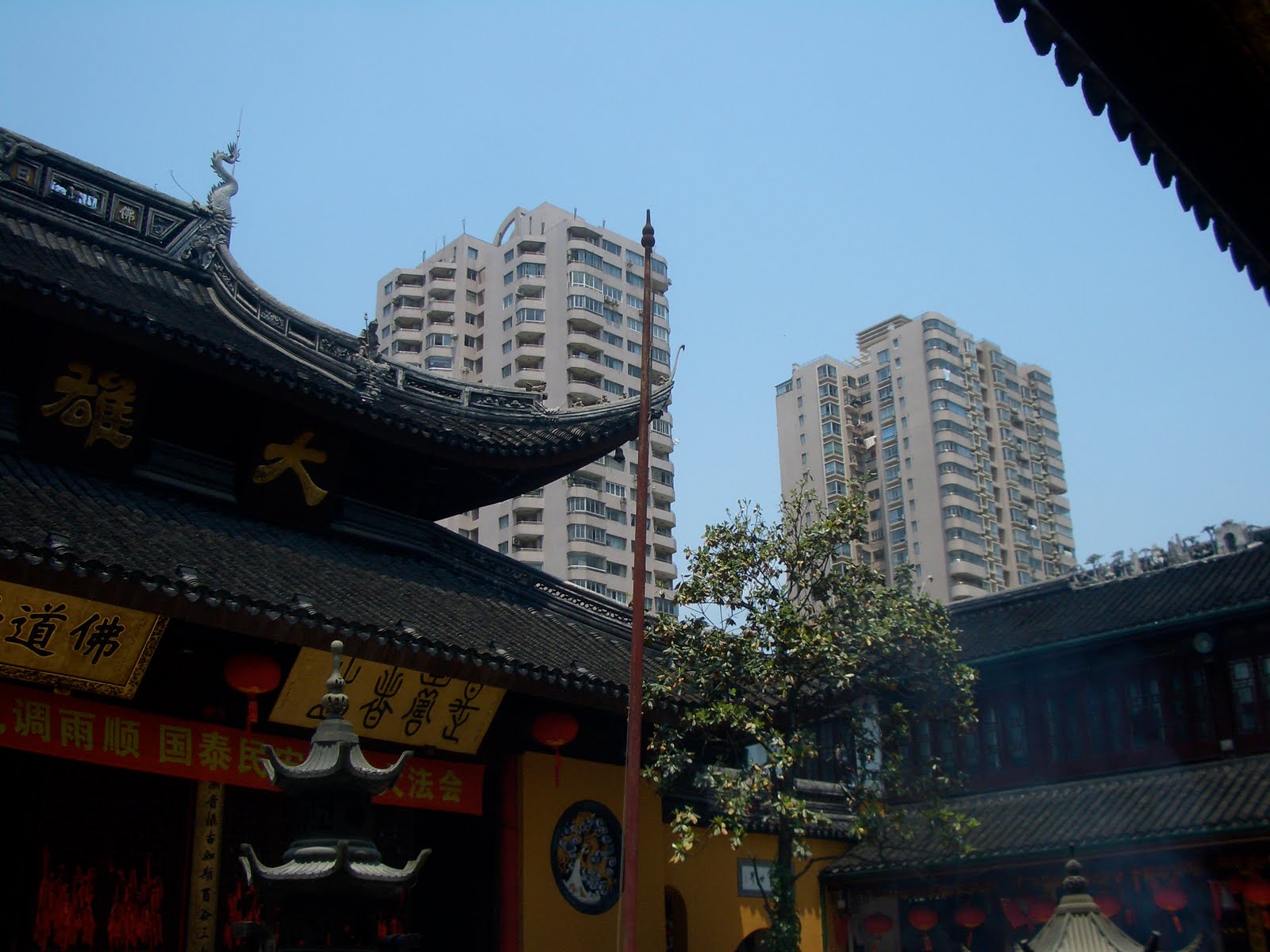
Old temple roofs and high rises share the skyline.

But contrast of old and new, small and large, is not just in contemporary building. It's everywhere in everything. Here, a well tended bonsai in a garden in Shanghai.

Ancient gnarly full-sized trees in the Confucius Temple in Beijing, yang to the yin bonsai.

I enjoyed a classic Peking opera performance of scenes from White Snake, with which I have become very familiar because of Vincent Zhao's performance in Green Snake,  and thanks to the opera company who did it in Honolulu not long ago, in English.
White Snake in Beijing
Later that evening,  I tuned in to CCTV to find one of Madame Mao's patriotic revolutionary operas on Chanel 11, which was completely devoted to Chinese opera (or there was some sort of marathon going on).  The opera sounded the same, the gestures were the same...only the costumes (and perhaps the plot) were different.
The heroes of the revolutionary opera were the ones made popular in China Reconstructs -- Iron Man Wang and Lei Feng and Liu Yingjun...heroes for the people.

No matter how much China reconstructs, there is an underlying tao to it all. I recognized CCTV's building under construction in 2007.

Now finished,  it is a centerpiece of the developing "civilized Chaoyang" district.

If I return to China in the next year or so, I doubt I will recognize the neighborhood.  The new will become old, something yet unconceived will rise higher.  I took a cab in Beijing to The Summer Palace, (where the Empress Dowager built her infamous marble boat) and I did manage to find a moment of peaceful respite from development and modernity.  That's why the Empress retreated there too, I think.

In 1988 to get to the Summer Palace, we rode bicycles on an unpaved country road along a canal that served duck farms.  I barely recognized the route this year; clogged freeways lined both sides of the canal, which ran through an area of high-rise residences and other city buildings.

But at least, after a visit to the "Temple of Timely Rains and Extensive Moisture" (not making this up) I found that some things may not change.
Rain, Water, Willows

While doing the links for this blog post,  I discovered that China Reconstructs is no longer called that: the new name of the journal is China Today.  And  China Tomorrow is coming on fast. 

Sunday, May 2, 2010

Testing, Testing

Testing ability of new iPad for posting. Wanted to not have to carry laptop. A little slow on 3G but that probably won't work in China anyway. Keyboard not bad. But seems that I have to use HTML option to enter post text. (But the pad spell-checker is great.) And don't have--yet--a camera connector so may not be able to post photos.

We'll just have to wait and see. I wanted this thing for travel, but failed to get the first shipment, wifi-only version had sold out. Would the 3G arrive in time? It did! A short wait in a line at store opening bell, very efficient and energetic, I got satisfaction!

I have always believed, tried to act as-if, at least, if you go with the flow, without anxiety, things work out. Someone told me I might be disappointed if I could't get my new toy. I had pretty much assumed I wouldn't. But now I'll never know if my attitude was actually well adjusted.

Sunday, March 28, 2010

In Tao There is No East or West

...there is no north or south.

Such is the lyric of an old turn-of-the-century (i.e., 19th to 20th)   hymn, in the Episcopal hymnal at least, but of course it was "In CHRIST there is...".  Whatever.  I always liked that old late Buddhist Episcopalian John Fahey's syncopated version.

I was painting today, and working from an early Ming image accompanying verse 57 in "The Illustrated Tao Te Ching," a pretty little thing which features James Legge's somewhat archaic god-infused translation.

My little ink homage (not quite finished) is hardly worthy, but it made me recall the classic American transcendentalist painting that illustrated something by Thoreau or Emerson or William Cullen Bryant in my middle school English reader (probably yours too). (In my painting, see the little guy under the tree?)  I found it in just minutes, tracking down the "Hudson River School", and was slightly startled to realize it is NOT in black and white (as rendered in that old textbook).

In Tao there is no black or white, either.  The title of the colorful painting is Kindred Spirits. It must have been speaking to me as I painted today.